
TLDR: Assess the operation, not the explosion
This Commander threat assessment guide has one central rule: target the player whose position is most likely to become lethal, dominant, or impossible to contain—not automatically the player with the largest creature. Before attacking or spending removal, inspect repeatable engines, usable mana, cards in hand, combo access, command-zone value, graveyard recursion, available interaction, and political consequences.
Then ask one question: If nobody acts for one full turn cycle, whose position improves the most? That question has prevented more tactical disasters than shouting “That creature is a 12/12” while a different player quietly assembles unlimited mana. Poor threat assessment is not bad luck. It is a preventable operational failure.
What threat assessment means in Commander
Threat assessment is the process of deciding which player, permanent, or resource deserves attention right now. It is not a lifetime judgment against the person who countered your commander two turns ago. Revenge is not strategy. Revenge wearing sunglasses is still revenge.
Commander is usually a multiplayer free-for-all in which you may attack different opponents during the same combat. That freedom means your attacks and interaction can be distributed according to actual danger rather than habit. Players normally begin at 40 life, while 21 combat damage from the same commander can eliminate a player, so ordinary life totals and commander-damage exposure must be evaluated separately. The official Commander format overview explains these foundational rules.
A useful assessment considers four dimensions:
- Lethality: Can this player win, eliminate someone, or create a lock now?
- Velocity: How quickly are their cards, mana, tokens, tutors, or other resources multiplying?
- Resilience: Can they rebuild, recur key pieces, or protect the plan after disruption?
- Political cost: If you act, who benefits, and does your action expose the table to something worse?
Classify each opponent as immediate, developing, or low priority. Do not assign elaborate scores. A number such as 8.4 creates the illusion that you have installed military radar beneath the playmat. You have not. You need a defensible priority, not decorative precision.
The one-turn-cycle test
Imagine the table takes no hostile action until your next turn. Nobody attacks the relevant player, removes a permanent, counters a spell, or exiles a graveyard. Whose position changes most dramatically?
The player with one giant attacker might deal substantial damage. The player with a repeatable draw engine, abundant mana, and seven cards may convert that turn cycle into several permanent advantages or a win attempt. The first threat is visible. The second has logistics.
Use the test at the beginning of each turn and again before committing interaction. New information changes the perimeter. A tutor, burst of mana, recursion spell, or commander entering the battlefield can instantly reorder the table.
A Commander threat assessment guide to the eight signals
1. Find repeatable engines
An engine repeatedly converts one resource into another: mana into cards, creatures into Treasures, spells into tokens, permanents into damage, or the graveyard into a second hand. Engines matter because they continue generating advantage unless somebody interrupts them.
Ask three questions. Does it trigger or activate repeatedly? Does it produce more resources than it consumes? Can those resources immediately advance the player’s plan? A draw engine with no usable mana may be developing. The same engine beside abundant mana and a compact win condition may be immediate.
Do not confuse spectacular output with durable output. One enormous creature can be blocked, bounced, or destroyed. A modest permanent drawing two extra cards every turn may keep supplying threats long after the enormous creature has completed its dramatic but brief audition.
2. Count usable mana, not just lands
Count untapped lands, mana artifacts, mana creatures, Treasures, cost reduction, and obvious burst resources. Then separate mana available now from mana expected next turn. Ten tapped lands may represent future capacity. Three untapped lands and several Treasures can represent an operation already in progress.
Also ask what the mana can cast. Available colors and restrictions matter. A large mana count is less urgent when it cannot support the suspected line, although it may still enable a different one. Strong mana bases make decks more consistent; understanding how those resources are built also helps you read opposing development. Our Commander mana base guide explains that infrastructure from the deckbuilding side.
3. Read hand size in context
A large hand is a warning, not a conviction. Cards become threatening when a player has the mana, selection, commander, or payoff needed to use them. Nine cards with little mana may indicate future strength and a possible discard problem. Five cards with extensive mana and a known engine may be far more dangerous.
Watch behavior as well as quantity. A player who repeatedly declines to develop the battlefield may be holding interaction, waiting for a better window, or simply holding cards that do not help. Treat those as possibilities, not facts. Hidden information is exactly that: hidden.
4. Recognize combo potential without inventing evidence
Do not treat every unfamiliar permanent as proof of a combo. Instead, identify the probable payoff, the pieces already visible, what appears to be missing, and whether the player can assemble and protect the line now.
Tutors, repeated card selection, recursion, cost reduction, sacrifice outlets, and large bursts of mana can increase urgency because they reduce the distance between the current position and a win. Still, suspicion should produce questions and contingency planning—not a prosecution based on ominous artwork.
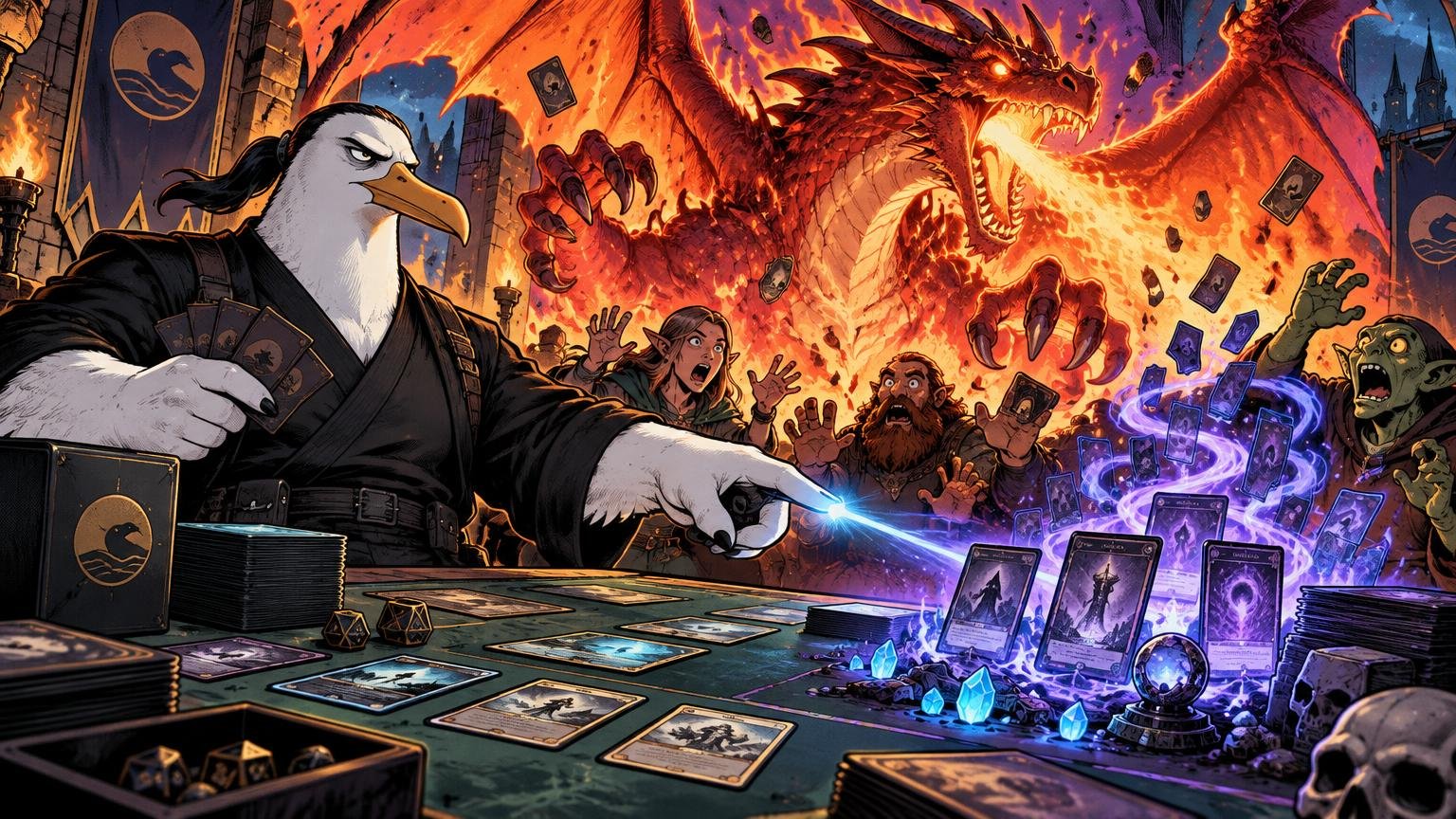
If you know a partial combination is dangerous, explain the exact concern to the table: “That permanent supplies the outlet, and the commander provides repeatable access to the other function.” Specific information builds a useful coalition. “I have a bad feeling about this bird” does not. I say this as a bird.
5. Determine what the commander actually does
A commander is reliably accessible from the command zone, although each previous cast from that zone adds two generic mana to its next command-zone casting cost. That repeatable access can make the commander an engine, enabler, outlet, tutor, payoff, or compact win condition.
Before removing it, ask whether the commander is the plan or merely a visible part of it. Destroying an engine commander before it generates value can be excellent. Repeatedly removing a replaceable attacker while its controller builds an independent draw-and-mana machine may waste cards and political capital.
Commander damage can create a separate emergency. If a player is approaching 21 combat damage from one commander, the attacker may deserve immediate attention even when another player has the stronger long-term engine. Track that clock cleanly; the Commander damage tracking guide covers the rule and practical record-keeping.
6. Treat graveyards as accessible resources
A large graveyard is not automatically dangerous. It becomes dangerous when the player can retrieve, reuse, copy, or otherwise exploit its contents. Look for a known reanimation target, a reusable spell, a recursion engine, a recoverable combo piece, or a commander that interacts directly with the graveyard.
The important question is not “How many cards are there?” It is “Which of those cards can matter, how quickly, and through what access point?” Twenty irrelevant cards are debris. One game-ending target beside an available recursion effect is an active device.
7. Account for interaction
Untapped mana and cards in hand can represent protection, removal, counterspells, or nothing useful. You cannot know with certainty, but you can plan around the possibility. Consider which player can stop the leading threat and whether forcing that player to spend resources helps or harms the table.
Holding interaction is often stronger than firing it at the first acceptable target. Spend removal when the threat will create meaningful advantage before another safe window, when it enables an imminent win, or when waiting sharply reduces your chance to answer it. Hold when the target is easily recoverable, a faster threat exists, or another player is better positioned to answer the problem.
8. Use politics as information
Commander politics should connect actions to board impact. Explain what happens if nobody intervenes, propose limited cooperation, and avoid promising more than necessary. “If you attack elsewhere, I will not remove your creature this turn” is a bounded agreement. “We are allies forever” is how paperwork begins.
Before removing the apparent leader’s best permanent, ask whether that player is containing somebody more dangerous. A defensive creature may be preventing lethal combat. Held-up interaction may be discouraging a combo attempt. Eliminating those safeguards can improve the wrong player’s position.
Politics becomes kingmaking when the primary purpose is deciding who wins rather than improving your own realistic chance to survive or win. Exact boundaries depend on the table, but board-based explanations are healthier than grudges. Attack the position. Do not conduct a three-game vendetta because somebody destroyed your mana rock.
What should you remove first?
| Possible target | Question to ask | Common reason to wait |
|---|---|---|
| Large attacker | Can it eliminate a player, deliver lethal commander damage, or create decisive pressure now? | It may be blockable, pointed elsewhere, or less dangerous than an engine. |
| Draw engine | How many cards will it generate before another safe answer window? | The controller may lack mana or a way to convert cards into progress. |
| Mana engine | Does it enable a win, overwhelming turn, or repeated acceleration? | The mana may not yet connect to a meaningful payoff. |
| Commander | Is it the engine, outlet, tutor, or win condition? | Removing it may only delay a plan supported by stronger infrastructure. |
| Graveyard setup | Is there active access to a consequential target or reusable effect? | A large graveyard without access is not an immediate emergency. |
| Partial combo | Can the player find the missing piece and protect the line now? | The line may be incomplete while another player presents a confirmed threat. |
There is no permanent category that must always die first. Prioritize conversion: the point at which resources become a win, lock, elimination, or advantage that the table cannot reasonably unwind.
Adjust for casual, optimized, and cEDH tables
At many casual tables, slower development provides more time to verify a threat, negotiate, and recover from a mistake. Visible combat and value engines may be the main dangers. At optimized tables, efficient tutors, fast mana, compact combinations, and protection can shorten the warning period. In cEDH, a restrained battlefield does not imply safety; hands, mana efficiency, stack interaction, and known win lines carry much more weight.
These are tendencies, not guarantees. Establish expectations before the game. Ask about intended pace, combo use, tutors, heavy resource denial, and the general level of interaction. If proxies are part of that discussion, separate budget from power: an inexpensive stand-in can represent either a harmless theme card or a highly optimized staple. The proxy etiquette guide for new Commander groups provides a practical conversation framework.
Wizards also presents Commander Brackets as an optional beta tool for discussing expected play experiences, with lower brackets focused more heavily on social play and higher brackets allowing stronger or competitive strategies. Treat brackets as a conversation aid rather than a substitute for describing what a deck actually does.
Final threat-assessment checklist
Before declaring attacks or deploying interaction, run this scan:
- What resource generation repeats?
- Who can win, eliminate someone, or establish a lock now?
- Who has the mana to convert cards into action?
- Which commander provides reliable access to an engine or payoff?
- Which graveyard has an active access point?
- Who appears capable of protecting or stopping a win attempt?
- Who benefits if I remove this permanent or attack this player?
- Whose position improves most if nobody acts for one turn cycle?
The loudest permanent is sometimes the real threat. Shoot it when the evidence supports the decision. But scan the engines, logistics, recovery routes, and political perimeter first. Your removal spell is a limited tactical asset, not a panic button with card art.
Identify what converts resources into victory, act at the last responsible moment, and preserve answers for threats that actually matter. The table may still descend into chaos. Commander does that. At least it will not be your chaos.