
TLDR: Respect the Islands, but do not surrender to them
Commander blue player threat assessment begins with one rule: untapped blue mana is evidence of possible interaction, not proof of a counterspell. Ask four questions before committing your spell: Can this opponent interact? Can the possible interaction answer this specific spell? Will the opponent spend it here? What does the battlefield look like afterward?
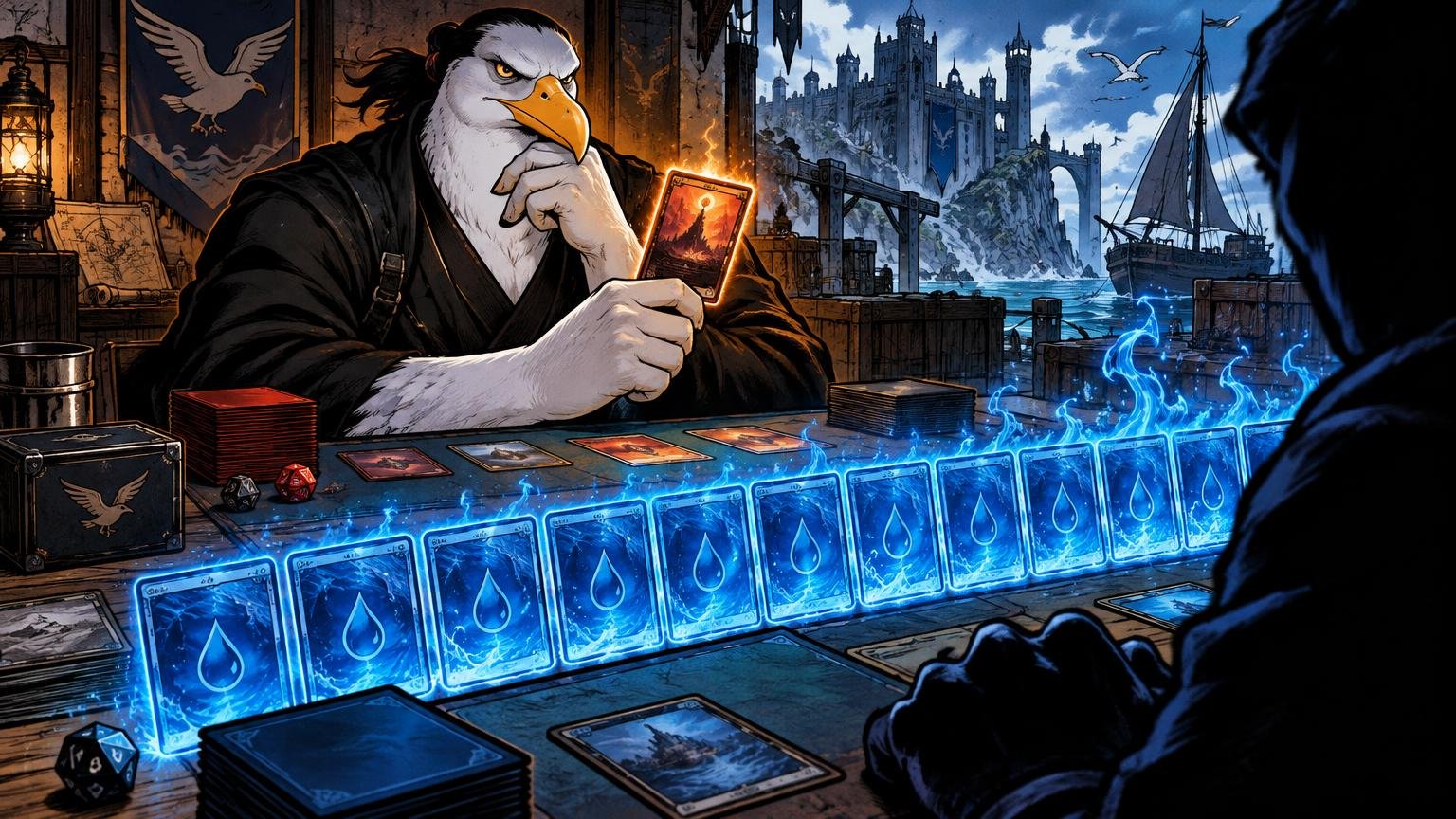
I once watched a man sit behind twelve untapped Islands while maintaining the expression of a lighthouse keeper who knew exactly where the rocks were. He was not necessarily my enemy. He was also not getting access to the launch codes. The correct response was disciplined sequencing, not panic.
Open mana matters because it preserves options. Your mission is to estimate those options using visible information, then make the play with the best acceptable outcome. You cannot inspect an opponent’s hand through sustained eye contact. I have tried. It only changes the seating arrangements.
Open blue mana is a warning light, not a confession
A blue player leaving mana untapped may have instant-speed interaction. They may also have card draw, an activated ability, a flash threat, no relevant card at all, or a deep commitment to making everyone uncomfortable. The mana tells you what is possible. It does not tell you what is present.
Do not automatically treat the blue player as the table’s primary threat. Judge the whole battlefield using the same standards you would apply in a broader Commander threat assessment. A player threatening to win now is usually more urgent than a player who merely could stop somebody from winning.
Use this four-part interrogation before casting anything important:
- Can they interact? Check available colors, untapped mana sources, usable permanents, cards in hand, and any known non-mana options.
- Can they interact with this? Possible responses may be limited by what they can target, what they can afford, or other restrictions. “Has blue mana” is not the same as “can answer every spell.”
- Will they interact? Consider whether your spell threatens them, threatens the table, protects someone else, or is smaller than another danger they may expect.
- What happens if they do? Decide whether trading your spell for their interaction improves or worsens your position, and whether another player can exploit the exchange.
The reconnaissance checklist
Begin with observable information. Commander is commonly played as a multiplayer free-for-all, so turn order and the incentives of several opponents matter at once. The official Commander format overview describes the format as generally involving three to five players. One opponent holding up interaction is making decisions across an entire table, not merely across from you.
- Available mana: Count usable sources and colors, not decorative lands that are tapped, restricted, or otherwise unavailable.
- Cards in hand: A large hand creates more possible responses, but still proves nothing about its contents.
- Known information: Check revealed cards, graveyards, exile, face-up effects, and anything previously returned to hand.
- Board resources: Untapped permanents and visible activated abilities can matter as much as cards in hand.
- Commander identity and demonstrated plan: Use what the deck has actually shown you. Do not promote stereotypes into intelligence reports.
- Turn order: Ask who can act after you and what threats may arrive before the blue player’s next turn.
- Table stakes: Identify who benefits if your spell is stopped and who benefits if the blue player saves the response.
This is incomplete information, not supernatural divination. Your conclusion should sound like “interaction is credible” or “interaction is less likely,” not “he definitely has it because he adjusted his glasses.” People adjust glasses. Sometimes because a seabird has landed on the table.
Understand counterspell range
“Counterspell range” is strategic shorthand for the set of responses an opponent could plausibly use with the resources currently available. It is not a formal rules term, and it is never unlimited.
A possible response may care about the kind of object being targeted, the amount of mana available, or another condition written on the card. You do not need to name every possible answer. You need to ask whether the spell you are casting falls inside a credible category of interaction.
For example, a permanent spell, an instant or sorcery, an activated ability, and a triggered ability are not interchangeable targets. An opponent representing an answer to one category may be unable to touch another. Read known cards carefully and avoid treating all open blue mana as a universal shield.
Mana count also changes the range, but not in a simple one-mana, two-mana, safe-at-zero progression. More available resources generally support more possibilities. Meanwhile, some interaction may use alternative costs or no mana at the moment it is deployed. Tapped-out is useful information, but it is not always an all-clear signal.
Priority and the stack, without the smoke grenade
When a player casts a spell or activates an ability, players receive opportunities to respond through the priority system. A spell or ability resolves only after every player passes priority consecutively. Once it begins resolving, nobody receives priority in the middle of that resolution.
This creates the operational window. You cast the spell, opponents may respond in turn order, and further responses can be added before the stack resolves. Understanding that window prevents the common mistake of treating a cast spell as though its effect has already happened.
If your spell is countered, it does not resolve. Costs already paid are generally not refunded. The mana is gone. Any sacrifice or other cost you paid remains paid. The mission has encountered what procurement calls a nonrecoverable expense.
The practical lesson is to separate casting from resolving. Announce the spell clearly, make legal choices required at that time, pay its costs, and give the table a reasonable opportunity to respond. Do not rush directly into applying the effect because everyone looked sleepy.
Sequencing doctrine: probe, commit, or force the issue
Lead with a lower-priority spell when the exchange helps you
A probe is a spell you are willing to resolve but can afford to lose. Leading with it may reveal whether an opponent is eager to interact, encourage them to spend mana, or improve your later decision. This is useful when both outcomes favor you: either the probe resolves, or it draws a response you are happy to trade for.
Do not cast meaningless bait merely because the word “bait” sounds tactical. If the blue player correctly ignores it, you have spent resources and learned almost nothing. Good bait must matter enough that responding is plausible.
Cast the real threat when delay is worse
Sometimes the correct move is to cast the spell you actually need. Waiting may give opponents more mana, more cards, or a better battlefield. If your threat addresses an immediate danger or creates a strong position even after an exchange, excessive caution becomes its own tactical failure.
Ask what changes by waiting one turn cycle. If the likely answer is “three opponents draw cards and somebody may win,” proceed with the operation. Fear of an unconfirmed counterspell should not become a private extra turn for the rest of the table.
Preserve protection only when it protects the mission
If your hand contains a way to defend the important spell, budget for it before casting. Count the complete cost of the sequence rather than discovering halfway through that confidence is not a mana source.
Protection also has opportunity cost. Holding resources forever can leave you functionally tapped out of progress. Decide in advance what outcome deserves protection and what exchange you will allow.
Plan for both branches
Before committing, imagine two battlefields: one where the spell resolves and one where it does not. If either branch leaves you exposed to the next player, adjust your line. Strong sequencing is not about guaranteeing success. It is about avoiding a result you failed to consider.
Multiplayer incentives change the firing decision
In a duel, stopping your threat may be an obvious use of interaction. In Commander, the blue player may need to account for threats from several players. They might conserve an answer for something more dangerous, something aimed directly at them, or a potential winning play later in the turn cycle.
This is where politics becomes useful rather than theatrical. Explain why another threat deserves attention, but do not demand that an opponent spend a card for your benefit. They control their resources. Your job is to understand their incentives and present accurate information.
Turn order is crucial. If two threatening players act after you, the blue player may be reluctant to use their only apparent response on your value engine. If you act immediately before that player’s turn, they may be more willing to spend resources because fewer unknown threats remain before they untap.
These are tendencies, not guarantees. A player may counter your spell because it attacks their plan, because they assessed it differently, or because you stole one of their fries in 2019. Strategic models have limits.
Five field scenarios
| Situation | Reasonable assessment | Practical response |
|---|---|---|
| One untapped blue source | Some interaction may be possible, but the plausible range is narrower than with abundant resources. | Check known information and decide whether your spell is important enough to cast into uncertainty. |
| Several untapped sources and a large hand | The opponent has broad capacity to act, although no specific answer is proven. | Sequence deliberately, consider a meaningful probe, and preserve resources for the post-response battlefield. |
| No available blue mana | Conventional blue interaction requiring blue mana is less credible, but other colors, permanents, or alternative costs may still matter. | Treat the signal as favorable rather than absolute permission. |
| A known non-mana response | Visible or previously revealed information outweighs vague assumptions based on land posture. | Plan around the known option and verify whether it can affect your specific play. |
| Several opponents act after you | The blue player must weigh your spell against threats that may appear later in the turn cycle. | Consider whether your play is urgent, expendable, or likely to be ignored in favor of a larger danger. |
The scenarios are decision prompts, not probability tables. No responsible operative assigns a universal percentage to one untapped Island without knowing the deck, hand size, battlefield, and pod. That would be numerology wearing a tactical vest.
Test your interaction package before deployment
Threat assessment improves when you have played from both sides of the exchange. Build sample hands and practice deciding when the blue deck should hold interaction, spend it, or advance its own board. Proxy test decks for Commander brewing can help you test those choices before committing to a finalized list.
During testing, track whether your interaction is too narrow, too expensive for your normal turns, or competing with your commander and other core plays. Also examine the opposing side: does your deck collapse after one answer, or can it present several meaningful plays across consecutive turns?
Set pod expectations before the operation
Expected power affects how heavily you should plan around instant-speed interaction. A relaxed pod and a high-power pod may devote very different amounts of deck space and mana to stopping opposing plays. Ask about pace, consistency, interaction, and how quickly decks are built to threaten a win.
The official Commander materials describe Commander Brackets as optional, and Wizards has characterized them as a tool for pregame conversation rather than rigid matchmaking. Use that framing to start a useful discussion, not to conduct a border inspection.
A clear conversation will not reveal anyone’s hand. It can tell you whether the pod expects frequent stack interaction, lighter disruption, or highly efficient answers. That context improves your initial threat model before the first Island reaches the battlefield.
Final debrief
Respect open blue mana because it represents options. Do not fear it as proof. Count the available resources, identify what kind of interaction could matter, consider the opponent’s multiplayer incentives, and compare the outcomes if your spell resolves or gets stopped.
Then make the play. Sometimes you probe. Sometimes you wait. Sometimes you place the important spell on the stack and invite the lighthouse keeper to produce credentials.
The man with twelve untapped Islands was not my friend. But he was also not automatically holding the answer. Commander is won through decisions made with incomplete information. Observe carefully, sequence with purpose, and never let an imaginary counterspell control more of the game than a real one.