
TLDR
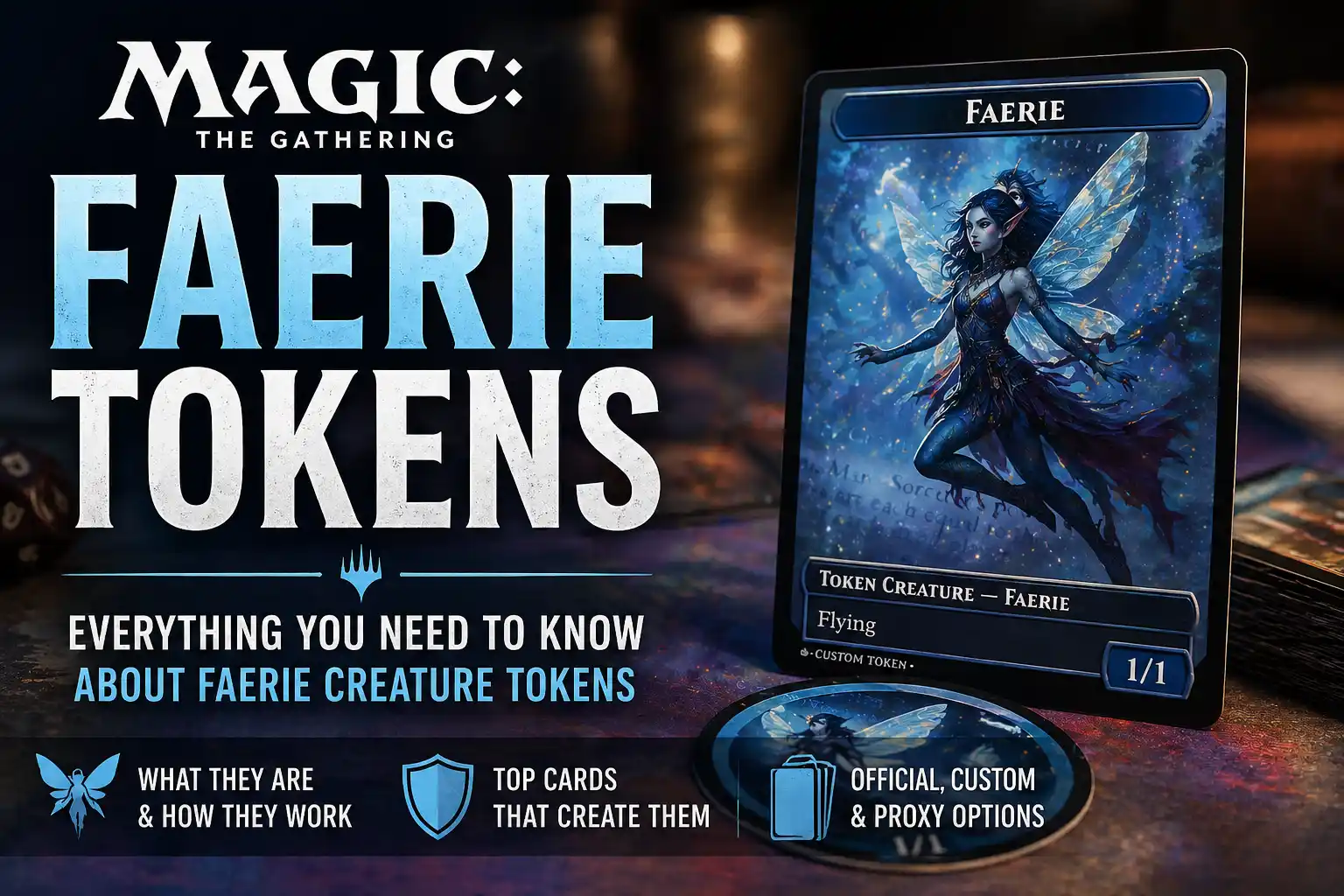
Magic: The Gathering Faerie tokens are creature tokens, usually 1/1 flyers, created by cards like Bitterblossom, Alela, Artful Provocateur, Oona, Queen of the Fae, and Faerie Formation.
They are not cards in your deck. They are battlefield markers that represent creatures created by spells and abilities.
Faerie tokens are especially useful in Commander, Cube, and casual decks because they attack in the air, trigger typal payoffs, carry equipment well, and build a board without spending extra cards.
For a nicer play experience, you can use official tokens, custom tokens, or printed proxy-style tokens from a service like PrintMTG’s MTG proxy printing page.
Faerie Tokens Are Small, Annoying, And Usually Better Than They Look
Faerie tokens do not look like much at first. A 1/1 flyer is not exactly Emrakul. It is not even a medium-sized draft common most of the time.
But Magic: The Gathering Faerie tokens are one of those small game pieces that add up quickly. One Faerie pecks in for damage. Two Faeries start pressuring planeswalkers. Three Faeries make combat awkward. Add an anthem, a tribal payoff, or a commander that cares about evasive creatures, and suddenly those little 1/1s are doing real work.
That’s the charm of Faeries in MTG. They are rarely about one giant battlefield moment. They are about tempo, evasion, flash-speed pressure, and making your opponent answer a board that keeps growing in the air.
And yes, sometimes they also just hold a Sword and ruin someone’s afternoon. Very on brand.
What Are Magic: The Gathering Faerie Tokens?
Magic: The Gathering Faerie tokens are creature tokens with the Faerie creature type. Most of the well-known versions are 1/1 creatures with flying, often blue, black, or blue-black depending on the card that created them.
A token is not a normal card in your deck. It is a game object created by another card’s spell or ability. You can represent it with an official token card, a custom token, a dry-erase token, a sleeved proxy token, or some other clear marker.
The important part is that both players can understand what it is.
A typical Faerie token might be:
1/1 blue Faerie creature token with flying
Or:
1/1 black Faerie Rogue creature token with flying
Or:
1/1 blue and black Faerie Rogue creature token with flying
The subtype can matter. “Faerie” matters for Faerie typal payoffs. “Rogue” can matter for Rogue payoffs. Flying matters for combat, damage triggers, and cards that care about creatures with flying.
How Faerie Tokens Work In MTG Rules
Tokens are permanents while they are on the battlefield. That means Faerie tokens can attack, block, be destroyed, be bounced, be exiled, be sacrificed, get counters, get equipped, and be affected by board wipes.
They are not cards, though. That distinction matters.
If a Faerie token dies, it goes to the graveyard briefly and then ceases to exist as a state-based action. It can still trigger abilities that care about a creature dying, but it will not stay in the graveyard.
So if you sacrifice a Faerie token to Ashnod’s Altar, you still sacrificed a creature. If Blood Artist sees it die, Blood Artist still triggers. But you cannot reanimate that token later because it no longer exists.
That’s the short version: on the battlefield, treat Faerie tokens like creatures. Once they leave the battlefield, don’t expect them to hang around.
Common Cards That Create Faerie Tokens
Faerie tokens show up in a few different styles. Some cards make one token at a time. Some cards make a token every turn. Some cards can make a huge swarm if the game goes long.
Here are some of the big names.
Bitterblossom
Bitterblossom is the classic Faerie token card. At the beginning of your upkeep, you lose 1 life and create a 1/1 black Faerie Rogue creature token with flying.
That is a very good deal if the game goes long.
Bitterblossom gives you a steady stream of evasive creatures without asking you to keep spending mana. The life loss matters, especially against aggressive decks, but Commander players tend to be pretty comfortable paying life for material. Black mages signed that contract years ago.
Bitterblossom is also clean with sacrifice outlets, Skullclamp, anthem effects, and cards that reward creature deaths or evasive attackers.
Alela, Artful Provocateur
Alela, Artful Provocateur makes 1/1 blue Faerie creature tokens with flying whenever you cast an artifact or enchantment spell.
That changes deckbuilding in a fun way. You are not just playing Faerie tribal. You are playing artifacts, enchantments, evasive tokens, and sometimes a little Esper nonsense. Alela also pumps your other creatures with flying, so the tokens hit harder than they look.
This is one of the better Faerie-token commanders if you want your deck to feel busy without needing every card to literally say “Faerie.”
Oona, Queen Of The Fae
Oona, Queen of the Fae is the old-school big mana Faerie commander. Her activated ability can exile cards from an opponent’s library and create 1/1 blue and black Faerie Rogue tokens with flying for each card of the chosen color exiled that way.
Oona is less about trickling out one token per turn and more about turning excess mana into a sudden air force. She also plays well with mill-adjacent cards, big mana, and control shells.
The deck can get mean if you build it that way, but it can also just be a cool Dimir Faerie deck that eventually floods the board with little flyers.
Faerie Formation
Faerie Formation is simple and practical. It can create a 1/1 blue Faerie creature token with flying and draw a card.
That’s not flashy, but repeatable token creation plus card draw is exactly what many slower Commander decks want. It gives you something to do with mana, builds your board, and keeps cards flowing.
Not every Faerie card needs to be a combo engine. Sometimes “make a flyer, draw a card” is enough.
Alela, Cunning Conqueror And Fae Dominion
Alela, Cunning Conqueror from the Fae Dominion Commander deck pushed Faerie typal back into the spotlight. She rewards you for casting your first spell during each opponent’s turn and creates Faerie Rogue tokens as part of that style of play.
That makes Faerie decks feel closer to how Faeries often play in competitive Magic: flash threats, countermagic, instant-speed removal, and lots of small decisions.
If you want a Faerie Commander deck that feels like it is playing Magic on everyone’s turn, Alela, Cunning Conqueror is a strong place to start.
Why Flying Makes Faerie Tokens So Good
The best part of most Faerie tokens is not the 1/1 body. It is flying.
Flying does a lot of quiet work:
- it pressures planeswalkers
- it chips in for combat damage
- it carries equipment well
- it blocks opposing flyers
- it dodges many ground stalls
- it makes anthem effects more dangerous
A 1/1 Soldier token often gets blanked by any random 2/2. A 1/1 Faerie token keeps attacking until your opponent has flyers, reach, removal, or a board wipe.
That is why Faerie tokens can feel much stronger than other 1/1 tokens in actual games. Evasion turns small stats into real pressure.
Faerie Token Decks In Commander
Faerie tokens are especially fun in Commander because the format gives them time to matter.
You usually want a few things:
Token makers: Bitterblossom, Alela cards, Oona, Faerie Formation, and other repeatable engines.
Payoffs: cards that pump flyers, reward attacking, reward tokens, or care about Faeries and Rogues.
Interaction: counterspells, bounce spells, removal, and flash-speed tricks.
Card advantage: draw engines that keep you from running out of gas.
Protection: cards that help your board survive sweepers or rebuild after one.
Faeries are not usually the biggest creatures at the table. You win by being evasive, annoying, and hard to fully pin down. You chip away while leaving up interaction. You force opponents to choose between answering your board or walking into your open mana.
That is a very Faerie way to win.
Best Commanders For Faerie Tokens
There are a few obvious commanders, and each one points the deck in a different direction.
| Commander | Colors | Best For |
|---|---|---|
| Alela, Artful Provocateur | White/Blue/Black | Artifacts, enchantments, flying tokens |
| Alela, Cunning Conqueror | Blue/Black | Flash-speed Faerie typal and control |
| Oona, Queen of the Fae | Blue/Black | Big mana, mill, token swarms |
| Tegwyll, Duke of Splendor | Blue/Black | Faerie typal, card draw, go-wide attacks |
| Talion, the Kindly Lord | Blue/Black | Faerie control and value-focused builds |
Alela, Artful Provocateur is probably the most flexible if you like tokens but do not want to play only Faerie cards.
Alela, Cunning Conqueror feels more like classic Faeries: play on opponents’ turns, keep mana open, and generate value while holding interaction.
Oona is the biggest and splashiest. She rewards mana production and can create a scary number of tokens late.
Tegwyll is the cleanest “yes, I am playing Faerie typal” commander. Sometimes that is exactly what you want.
Official Tokens Vs Custom Tokens Vs Proxy Tokens
You have a few good options for representing Faerie tokens.
Official tokens are easy if you already have them. They match Magic’s normal token style and are easy for opponents to recognize.
Custom tokens are better if you want your deck to have a stronger theme. Faeries are a great fit for custom art because the creature type supports so many visual styles: dark fairy tale, bright woodland, gothic, dreamlike, trickster, rogue, courtly, spooky, cute, and everything between.
Proxy-style tokens are the practical middle. They let you make a full matching set, keep your board clear, and avoid using random dice or mismatched scraps of paper.
For Commander especially, I like having a small stack of clean Faerie tokens ready before the game starts. If your deck can make ten or more tokens, you will appreciate not having to improvise.
Why PrintMTG Makes Sense For Faerie Tokens And Proxies
Faerie decks are one of those archetypes where the supporting pieces matter almost as much as the main cards. You might want custom tokens, proxy versions of expensive playtest cards, alternate art styles, or a full casual deck that matches visually.
That is where PrintMTG fits well.
PrintMTG is useful for players who want to print MTG proxies for casual games, Cube, Commander nights, deck testing, and custom card projects. Their proxy page lets you choose how you want to proxy: print from a decklist, start with a precon, design custom cards, or browse set printings.
For Faerie tokens, that means you can build a cleaner token package instead of relying on whatever official tokens you happen to own. You can also proxy expensive cards while testing different versions of a Faerie deck before buying every upgrade.
My practical recommendation:
Use custom printed Faerie tokens if you already know you love the deck.
Use proxy cards if you are testing expensive pieces before committing.
Use official cards when you are buying the version you want for your permanent deck.
That gives you flexibility without turning deckbuilding into a binder tax.
How Many Faerie Tokens Should You Keep With Your Deck?
This depends on the deck.
For a casual deck with only one or two token makers, five Faerie tokens is usually enough.
For Bitterblossom or Alela-style decks, I’d keep at least ten.
For Oona, Queen of the Fae, I’d keep more. Oona can make a lot of tokens at once, so you may want fifteen or twenty physical tokens, or a smaller number of tokens plus dice to mark multiples.
Here’s a quick guide:
| Deck Type | Recommended Faerie Tokens |
|---|---|
| Light token package | 3 to 5 |
| Bitterblossom deck | 8 to 12 |
| Alela token deck | 10 to 15 |
| Oona big mana deck | 15 to 25 |
| Full Faerie typal Commander deck | 12 to 20 |
You do not need a separate physical card for every token you might ever create. But you do want enough that the board stays readable.
Using one token with a die showing “8” is legal in many casual settings, but it gets messy once tokens become tapped, attacking, blocking, equipped, summoning sick, or affected by different counters. More physical tokens make the game easier.
Gameplay Tips For Faerie Tokens
Faerie tokens reward patience.
Do not throw them away too early unless you are gaining value from the trade. A 1/1 flyer often gets better the longer the game goes, especially if you have anthem effects, equipment, or cards that reward combat damage.
Attack planeswalkers aggressively. This is one of the best jobs for Faerie tokens. A single evasive creature can keep opposing planeswalkers honest.
Keep mana open when your deck supports it. Faeries are at their best when opponents have to respect your board and your untapped lands.
Watch for board wipes. Token decks are naturally vulnerable to sweepers. If your opponent is clearly setting up a wrath, sometimes the correct play is to stop extending and hold your next token engine until after the reset.
And count your damage. This sounds obvious, but Faerie decks can miss lethal because the board looks small. Three 1/1 flyers become nine damage very quickly if you add a lord, an anthem, or a couple of combat triggers.
Good Cards With Faerie Tokens
The best support cards depend on your colors, but Faerie tokens usually like these effects:
Anthems: cards that pump your team make small flyers into real threats.
Skullclamp: one-toughness tokens and card draw are old friends.
Coastal Piracy-style effects: if your little flyers connect, you get paid.
Favorable Winds: cheap flying anthem, simple and effective.
Kindred Discovery: strong in Faerie typal decks when you want card advantage.
Reconnaissance Mission: great with evasive token swarms.
Bident of Thassa: similar idea, with some extra political weirdness.
Countermagic: protects your board and fits the flash-control Faerie play pattern.
Sacrifice outlets: useful if your Faerie tokens are black or if your deck has death triggers.
The real trick is not jamming every payoff. Pick a plan. Faerie tokens can support tempo, control, typal aggro, aristocrats, enchantments, artifacts, or mill. The deck gets cleaner once you choose which version you’re building.
Are Faerie Tokens Good In Draft?
Sometimes.
Faerie tokens depend on the set. In a Faerie-heavy Limited environment, a 1/1 flyer can be excellent because it helps enable typal synergies and chips in through board stalls. In another set, it might just be a small evasive body.
The big question is support. If the set gives you cards that reward Faeries, flyers, tokens, or attacking with small creatures, then Faerie tokens can be real cards. If not, they are mostly small evasive attackers.
Still, never ignore a free flyer. Limited games are often decided by tiny chunks of damage that nobody respected on turn three.
Are Faerie Tokens Worth Customizing?
Yes, especially for Commander.
Faerie tokens are visible. They sit on the battlefield for multiple turns. They attack often. They multiply. If your deck makes tokens every game, upgraded tokens make the deck feel better to play.
This is one of the places where custom tokens are not just cosmetic. They also improve clarity.
A clean token can show:
- color
- creature type
- power and toughness
- flying
- Rogue subtype, if relevant
- art that matches your deck theme
That makes board states easier. It also makes the deck feel more intentional.
For Faeries, that matters. A pile of mismatched scraps does not quite sell “tricky magical air force.” A matching set of custom tokens does.
Common Mistakes With Faerie Tokens
The first mistake is forgetting that tokens are creatures. They can be sacrificed, destroyed, targeted, blocked by flyers, and affected by creature board wipes.
The second mistake is forgetting that tokens are not cards. They can trigger death effects, but they will not sit in the graveyard afterward.
The third mistake is using unclear markers. One die in the middle of the table can turn into a rules headache fast. Are they tapped? Are they summoning sick? Are two of them equipped? Which one has a counter? Not the most glamorous part of Magic, but clean token tracking prevents arguments.
The fourth mistake is underestimating chip damage. Faerie tokens often win games one damage at a time until the last turn, when they suddenly win by twelve.
That is the Faerie promise: small, evasive, irritating, and somehow lethal.
FAQs
What Is A Faerie Token In MTG?
A Faerie token is a creature token with the Faerie creature type. Most Faerie tokens are 1/1 creatures with flying, created by spells or abilities from other cards.
Are Faerie Tokens Cards?
No. Tokens are not cards, even if you use a card-shaped token to represent them. They are game objects that exist on the battlefield after an effect creates them.
What Happens When A Faerie Token Dies?
A Faerie token goes to the graveyard briefly, then ceases to exist. It can still trigger abilities that care about creatures dying.
What Cards Make Faerie Tokens?
Common examples include Bitterblossom, Alela, Artful Provocateur, Alela, Cunning Conqueror, Oona, Queen of the Fae, and Faerie Formation.
Can I Use Custom Faerie Tokens?
Yes. You can use official tokens or custom tokens as long as the game object is clear to all players. Custom printed tokens are popular in Commander because they make the board easier to read and give the deck a stronger theme.
Are Faerie Tokens Good In Commander?
Yes. Faerie tokens are useful in Commander because they fly, scale well with anthems, trigger combat-damage effects, pressure planeswalkers, and support Faerie typal strategies.
Conclusion
Magic: The Gathering Faerie tokens are small, but they do a lot of work.
They attack in the air. They block flyers. They trigger typal payoffs. They carry equipment. They feed sacrifice engines. And with cards like Bitterblossom, Alela, Oona, and Faerie Formation, they can turn a quiet board into a real clock.
For casual play and Commander, I’d keep a clean set of Faerie tokens with the deck. Official tokens work fine. Custom tokens are better if you want the deck to feel polished. And if you’re testing a Faerie build or want a matching token package, PrintMTG is a practical place to start.
The main thing is clarity. Faeries may be tricky, but your tokens should not be.