
TLDR
Commander threat assessment is the process of identifying which player, permanent, or resource can most quickly convert into a win, a lock, or an overwhelming advantage. Do not automatically target the largest creature. First check for immediate win lines, lethal combat, repeatable engines, available mana, cards in hand, commander access, graveyard resources, protection, and political consequences. Then choose the lightest response that actually contains the danger.
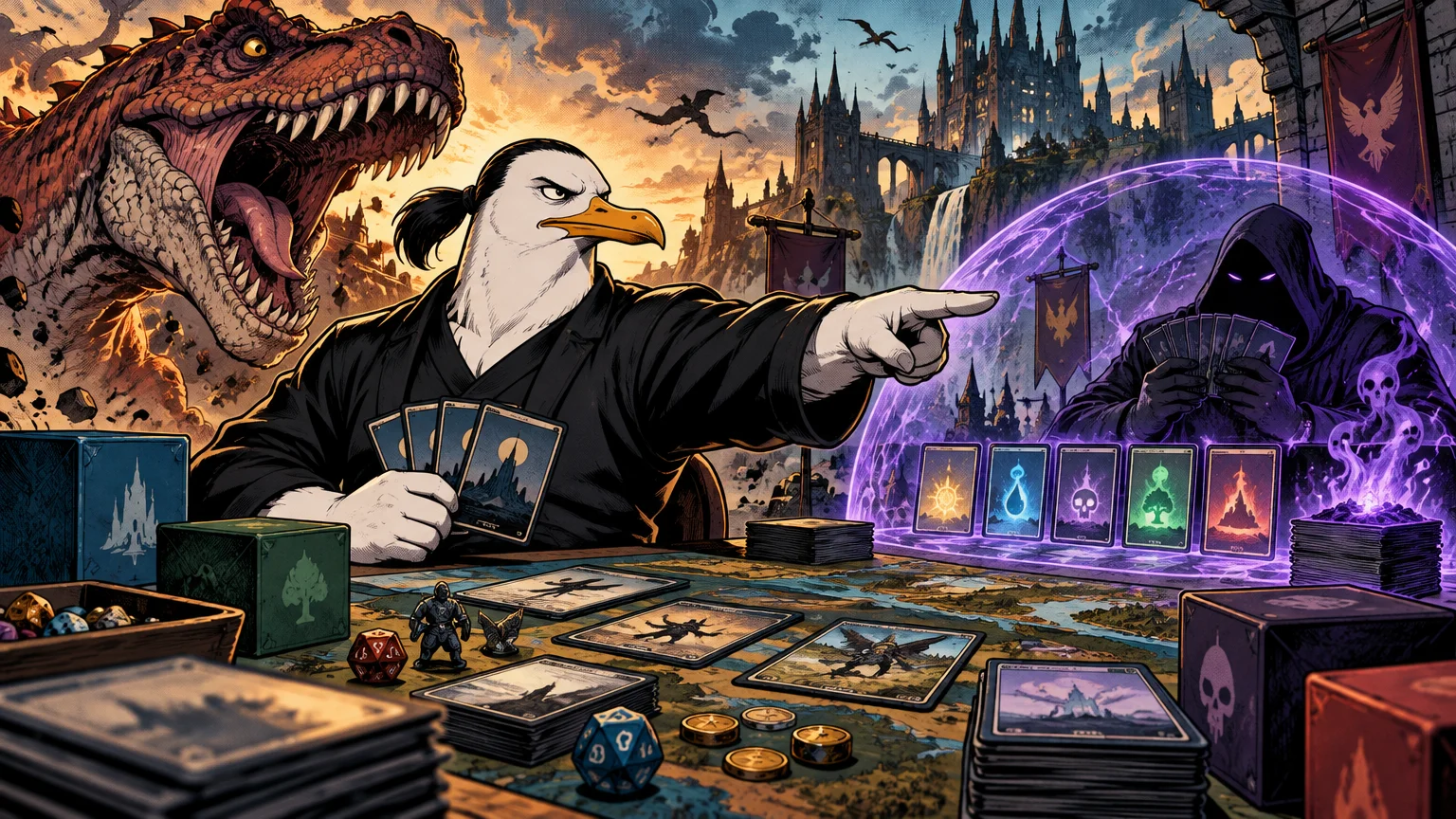
Operation: Do Not Shoot the Largest Dinosaur begins now. The loudest permanent is often dangerous, but volume is not the same as urgency. A giant creature may be one blocker away from irrelevance while the quiet player with six cards, untapped mana, and a carefully stocked graveyard is preparing to end the game without raising their voice. I respect restraint. I also monitor it closely.
Field log: Operation Do Not Shoot the Largest Dinosaur
Fictional dramatization
The table was surrounded. One opponent controlled a creature large enough to require its own weather system. Another had two harmless-looking permanents, a full hand, open mana, and the expression of someone who had already read the final page of the mission briefing. The table demanded immediate action against the dinosaur. I declined. Three imaginary helicopters circled overhead. Nobody asked why they were indoors.
The dinosaur could attack one player and was stopped by an available blocker. The quiet player, by contrast, had the resources to assemble and protect a winning sequence on the next turn. The correct target was not the most visually impressive object. It was the line most likely to convert existing resources into victory.
That scene is fictional, because indoor helicopters are expensive. The lesson is practical: assess what each player can accomplish before their next meaningful decision point. Board size matters, but it is only one part of the perimeter.
Commander threat assessment starts with a first-pass scan
Commander is built for multiplayer play, with opponents able to attack and target across the table. Its command-zone rules also let a player cast their commander again for an additional cost after previous casts from that zone. The official Commander format overview explains these structural rules. That multiplayer structure means every action changes several players’ incentives, not merely the battlefield in front of you.
Before studying every permanent, conduct a fast emergency scan. Ask these questions in order:
- Can anyone win now or during the next turn cycle? Look for an announced or known sequence, sufficient mana, required resources, and protection.
- Can anyone deal lethal combat damage immediately? Count attackers, relevant blockers, evasion, combat resources, and which players are actually exposed.
- Is a lock or denial effect about to prevent the table from meaningfully responding? A modest-looking permanent may be urgent if it closes the available escape routes.
- Will an engine create a decisive advantage if it survives one more turn? Repeatable cards, mana, tokens, recursion, or selection can become harder to contain after another activation.
- If none of those conditions apply, who is best positioned to become the next threat? This is where hand size, mana, commander access, and graveyard resources become decisive.
This ordering prevents a common failure: spending removal on a merely strong permanent while leaving an imminent win untouched. A threat can be real without being immediate. Immediate threats receive priority because there may not be another deployment window.
The seven-signal sweep
I use seven signals to build a working threat picture. None is conclusive alone. Together, they reveal which player has the strongest combination of capability, speed, and resilience.
- Board state: Count meaningful attackers, blockers, engines, sacrifice outlets, protection pieces, and permanents that restrict normal play. Do not use permanent count as a substitute for analysis. Ten disposable tokens and one repeatable value engine represent different threats.
- Mana: Check total available mana, untapped sources, temporary production, and whether the player can act at instant speed. Open mana does not prove interaction, but it increases the range of actions that player may take. Tapped-out players usually have fewer immediate options, although free or alternative-cost effects can complicate that assumption.
- Cards in hand: Hand size measures options, not guaranteed quality. A player with seven cards can rebuild, protect a line, or bluff more credibly than a player with one. Also ask how those cards were acquired. A deck drawing several extra cards each turn has logistics; a deck relying on its normal draw is operating on emergency rations.
- Engines: Identify repeatable sources of cards, mana, tokens, tutoring, recursion, or selection. An engine is dangerous when its next use materially improves the player’s position or creates another engine. Removing the payoff while leaving the production system intact can be like confiscating one sandwich while ignoring the sandwich factory.
- Commander access: A commander in the command zone remains a visible resource, although repeated casts become more expensive under the format’s command-zone rules. Consider what happens when it enters, whether the player has enough mana to cast it, and whether it immediately reconnects the deck’s machinery.
- Graveyard: Treat a graveyard as a public resource zone when the deck can recur or exploit it. Count relevant targets and enablers rather than staring at the total number of cards. A large graveyard without access may be inert; three carefully selected cards with recursion available may constitute an active incident.
- Interaction and known lines: Track revealed cards, previously demonstrated protection, likely removal, and win sequences the table has already seen. Do not pretend to know hidden cards. Instead, distinguish confirmed information from reasonable possibility. Known capability deserves more weight than theatrical suspicion.
Well-built decks often include reusable packages of ramp, draw, removal, and protection. Understanding those roles makes it easier to recognize what an opponent is representing; the same categories are useful when selecting your own Commander proxy staples. Threat assessment becomes clearer when you can identify what each resource actually does for the deck’s plan.
Classify the threat before selecting a response
| Threat category | What it looks like | Default response |
|---|---|---|
| Immediate winner | The player can plausibly complete a winning line now or before the table can prepare | Interrupt the line, remove a required piece, or coordinate interaction immediately |
| Snowball engine | Repeatable cards, mana, tokens, selection, or recursion will compound over several turns | Remove or disable the engine before the advantage becomes expensive to reverse |
| Lock or denial piece | A resource restricts casting, attacking, drawing, untapping, or otherwise participating | Break the restriction if it prevents meaningful counterplay or protects a win |
| Combat finisher | Attackers can eliminate a player or radically reshape the table | Use blockers, removal, attacks, or negotiation according to who is exposed |
| Hidden-resource player | The battlefield is modest, but the hand, mana, graveyard, or commander supports a strong line | Preserve interaction, pressure resources, and ask direct questions |
| Political decoy | A conspicuous threat attracts attention while another player gains quietly | Acknowledge the visible danger without donating the game to the quiet beneficiary |
These categories can overlap. A token engine may also be a combat finisher. A denial piece may protect an immediate win. When that happens, prioritize the function that ends the game or removes the table’s ability to respond.
Choose the lightest action that contains the danger
Correct identification does not automatically mean immediate removal. Your response should match the timing and severity of the threat.
- Remove now when a player can win, establish a hard-to-break lock, or gain an advantage that cannot reasonably be recovered after the next trigger or activation.
- Constrain with attacks when life, planeswalkers, or defensive resources are the relevant pressure points. Combat can force blocks, reduce protection, or make a player spend mana without consuming your premium removal.
- Hold interaction when the threat is conditional, another player can answer it, or using your spell now would expose the table to a more dangerous line. Holding removal is discipline only if you recognize the point at which waiting becomes fatal.
- Negotiate when multiple players benefit from the same answer. State the observed line and ask who can cover which stage. Good coordination prevents three removal spells from being fired at one target while the real win condition remains untouched.
- Ignore temporarily when a permanent is inefficient to answer, attacks someone else without creating an immediate disaster, or distracts the table from a more urgent engine. Temporary tolerance is not friendship. It is scheduling.
Before firing removal, ask what happens next. If destroying one player’s threat allows a third player to untap and win, your technically successful spell has completed the wrong mission. If a dangerous permanent has already generated its major value, removing the source may still matter—but compare that benefit with answering the next conversion point instead.
Scenario drills
The giant attacker versus open mana and a full hand
Player A has one enormous attacker. Player B has a small board, several cards, untapped mana, and graveyard access. Start by checking whether Player A can actually eliminate anyone. If the creature is blocked, lacks useful evasion, or can only injure a well-defended player, it may not be the emergency. Player B’s resources deserve scrutiny, especially if the table knows a compact winning line is available.
Do not reverse the mistake and automatically attack Player B either. Ask for relevant public information: available mana, cards previously revealed, commander capability, and graveyard targets. Threat assessment uses evidence. Paranoia merely wears a tactical vest.
The token army versus a protected combo window
A wide token board looks lethal because it occupies substantial cardboard territory. Count actual damage, blockers, and how many players are vulnerable. Then inspect the player who can attempt a win with protection available. If the token player needs another turn while the combo player can act now, the combo window is more urgent. If the tokens already present lethal against multiple players and the supposed combo is speculative, contain the battlefield instead.
The commander engine versus graveyard recursion
One player’s commander generates steady value. Another has stocked a graveyard and can recur a critical sequence. Compare time horizons. The commander may dominate after two more turns, but the graveyard player may be able to convert immediately. Stop the immediate conversion first, then reassess whether the commander engine has become the next priority.
Proxy test games are useful for learning these patterns without committing a decklist to permanent procurement. Repeated games with MTG proxy test decks can expose which innocent-looking resources are genuine setup pieces and which spectacular permanents are mostly noise.
Politics should transmit information, not manufacture fog
Useful table talk is direct and verifiable: “That player has enough mana to cast the commander and activate the engine,” or “If this graveyard piece returns, do we have another answer?” This gives opponents a reason to cooperate without pretending certainty about hidden cards.
Also disclose your incentive when it matters. If a creature can eliminate you but threatens nobody else, say so. The table may help, decline, or demand a concession. All are legitimate political outcomes. What matters is separating “this ends the game” from “this is extremely inconvenient for me.” I have survived many fictional negotiations by maintaining this distinction and standing near an open window.
Watch for the beneficiary of every proposed action. The player loudly demanding removal may be correct. They may also be the player who gains most once shields are lowered. Ask who becomes strongest after the target disappears. Politics is part of threat assessment because multiplayer resources are interdependent.
Pregame expectations help, but the battlefield remains in command
A pregame conversation can establish expected speed, tolerance for powerful strategies, and the kind of experience everyone brought. Proxy use should be discussed separately from deck strength; clear Commander proxy etiquette avoids confusing card price with power.
Wizards described Commander Brackets as a beta tool for guiding pregame conversations and expectations, not as a final authority that eliminates the need for discussion. The February 9, 2026 Commander Brackets beta update provides the official framing. Brackets can help establish the mission before shuffling, but they cannot tell you which player is dangerous on turn seven. Draws, decisions, revealed information, and changing alliances still determine that.
Closing doctrine
The real threat is the player or resource most capable of converting the current position into victory, a lock, or an advantage the table cannot reasonably recover from. Scan immediate wins first. Then evaluate combat, engines, mana, hands, commander access, graveyards, interaction, and political incentives.
On your next turn cycle, pause before targeting the largest permanent. Name the dangerous conversion line, estimate when it becomes active, and choose the smallest response that safely disrupts it. Shoot the dinosaur only when the dinosaur is actually the mission.