
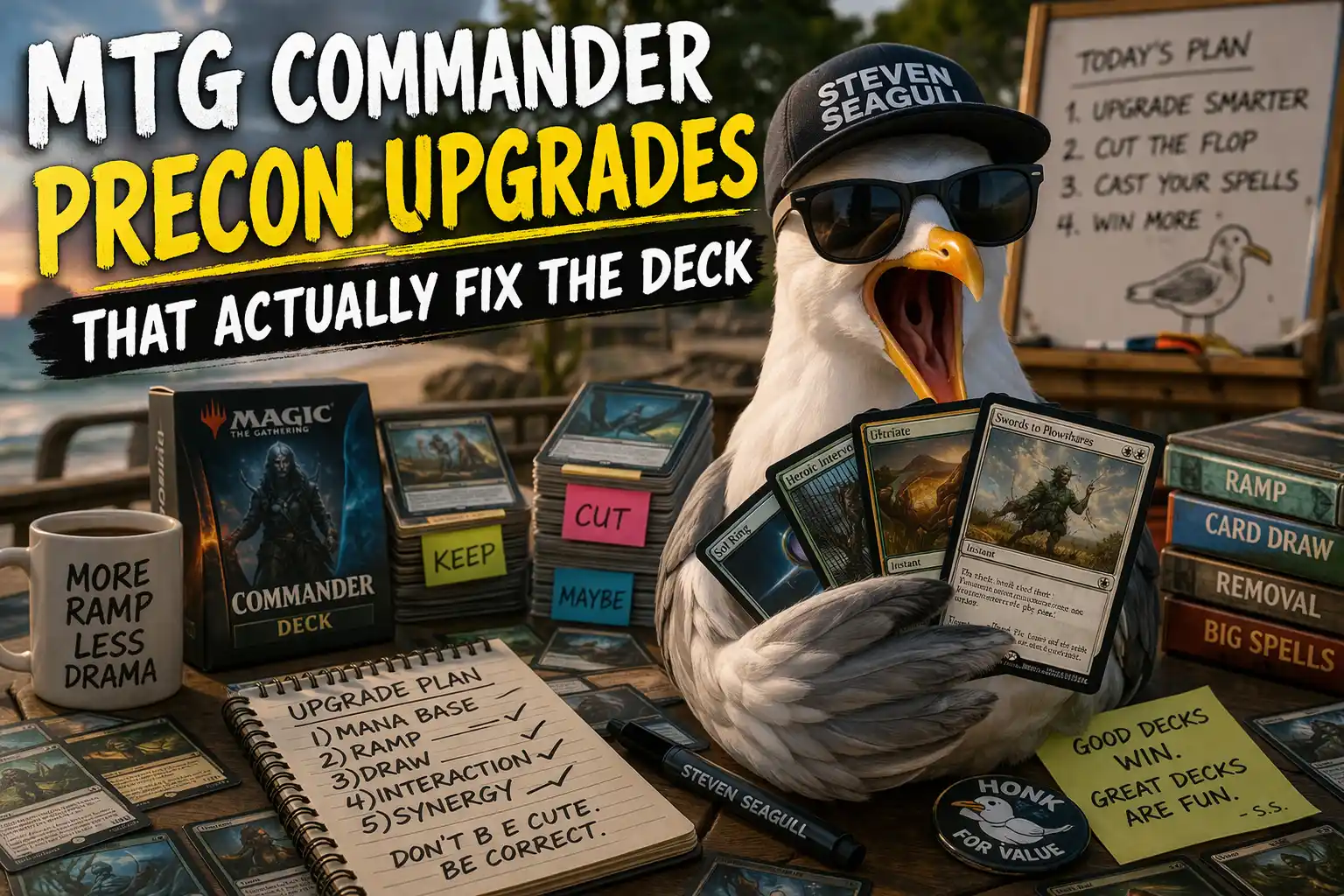
Everybody wants the dramatic makeover. New bombs. New staples. A shiny upgrade pile that makes the deck look dangerous even when it still stumbles on turn three. But most MTG Commander precon upgrades are not won there. They are won in the boring parts of the list. Lands. Ramp. Draw. A couple of clean cuts. Then suddenly the deck stops playing like it got dressed in the dark.
That is the thing people miss with precons. They are usually playable out of the box. They are not usually tuned for your table, your budget, or your patience. And if you start by swapping in the splashiest cards first, you often end up with a deck that is technically stronger and somehow worse at doing its actual job. Commander has a funny way of punishing vanity. Quietly. Repeatedly.
Why Most MTG Commander Precon Upgrades Miss
A precon usually is not bad. It is just trying to do too many things at once.
That sounds harsh, but it is normal. Precons are built to introduce a theme, show off new cards, and still function for a wide range of players. So you get a little ramp, a little removal, a little synergy, a little top end, and a couple cards that feel like they were added because someone got sentimental in the final meeting.
That is why random power upgrades can feel weird. You add one scary mythic, but the deck still draws clunky hands. You add one premium finisher, but your mana is still late. You add one “must answer” card, and the deck still spends half the game pretending it has a plan.
The fix is less glamorous. You need to figure out what the deck is actually trying to do at its best, then make that happen more often.
Fix The Mana Before You Buy Another Threat
If your precon cannot cast its spells on time, your first job is not finding a better seven-drop. Your first job is fixing the part that makes the deck function.
A lot of MTG Commander precon upgrades should start with the mana base and early ramp package. Not because that is exciting. It is not. Nobody has ever slapped the table and said, “Now this is podracing,” after swapping in a land. But better mana changes everything. Your opening hands improve. Your double-pipped cards stop rotting in hand. Your turns stop feeling like paperwork.
That also means being honest about your curve. If your commander costs five and your deck is packed with four-, five-, and six-mana spells, then adding another expensive value engine is usually not helping. It is just adding traffic.
If you want the short version of that conversation, MTG Proxies: Steven Seagull’s Guide to Faster Commander Decks points in the same direction.
Upgrade The First Four Turns
Most games are not decided on turn two. But a lot of Commander games are quietly shaped there.
If your first four turns are awkward, your precon will feel behind even when its late game is strong. So when I look at precon upgrades, I care a lot about the cards that smooth those early turns. Cheap ramp. Cheap card selection. Cheap interaction. A land count that does not make you pray to the top of your library like it owes you money.
This is where players often improve the deck the fastest. Not by making the ceiling higher, but by making the floor less embarrassing.
Ask simple questions:
Can I reliably cast my commander on time?
Can I spend my mana on the first few turns?
Can I draw out of a slow hand?
Can I answer one problem permanent without needing a full committee vote?
If the answer to those is “sort of,” that is where your next upgrades go.
Cut The Cards That Only Behave When You Are Already Winning
Every precon has a few cards that look powerful but only feel good once the game is already going well. Those are the cards that trick people.
They read like payoffs. In practice, they are often passengers.
A good cut is usually one of these:
A card that costs too much for what it does
A payoff with no support when you draw it alone
A side-theme card that never lines up with the main plan
A flashy card that gets stuck in hand while you die with manners
This part matters because real upgrades are not only about what comes in. They are about what finally leaves. And honestly, some precon lists improve the second you stop asking every card to be cute.
That is not a call to strip out the deck’s personality. Commander is supposed to have personality. Weird pet cards are part of the deal. But there is a difference between one pet card and eight cards that all need a moon phase, a board state, and emotional support to work.
Build Around The Commander’s Best Turn
The cleanest upgrade path is usually this: identify the best turn your commander can produce, then make that turn happen more often.
If your commander wants tokens, feed the token plan. If it wants graveyard volume, add cards that stock the yard and pay you for it. If it wants combat triggers, stop stuffing the deck with slow value pieces that never attack.
This sounds obvious. But precon tuning gets much easier when you stop asking, “What are the strongest cards I can add?” and start asking, “What makes my commander’s best turn show up sooner, safer, and more consistently?”
That question usually leads to better upgrades.
It also leads to smarter restraint. Sometimes the right upgrade is a protection spell, not another payoff. Sometimes it is a draw spell that keeps the hand full. Sometimes it is one more two-mana rock so the whole deck stops wheezing on turn four.
Not dramatic. Very effective.
Use A Clean 10-Card Upgrade Plan
If you want a simple way to make MTG Commander precon upgrades without turning the project into a lifestyle, try a 10-card pass.
Make ten changes only.
Do two mana base upgrades.
Do two ramp upgrades.
Do two draw or selection upgrades.
Do two interaction upgrades.
Do two synergy upgrades tied directly to the commander.
Then play the deck.
This works because it forces discipline. You are not rebuilding the whole list. You are fixing the parts that keep the deck from acting like itself. And after a few games, the next round of changes becomes much clearer.
A lot of decks do not need 25 upgrades. They need 10 good ones and someone to stop panic-shopping.
Final Thoughts
The best MTG Commander precon upgrades do not try to make the deck look impressive on paper. They make it function better at the table.
That means cleaner mana. Better early turns. Fewer passengers. More cards that support the commander’s actual plan.
And yes, that is less cinematic than adding the biggest haymaker in your binder. But it works. The gull may enjoy chaos, but even he knows a deck should be able to cast its spells before it starts throwing punches.