
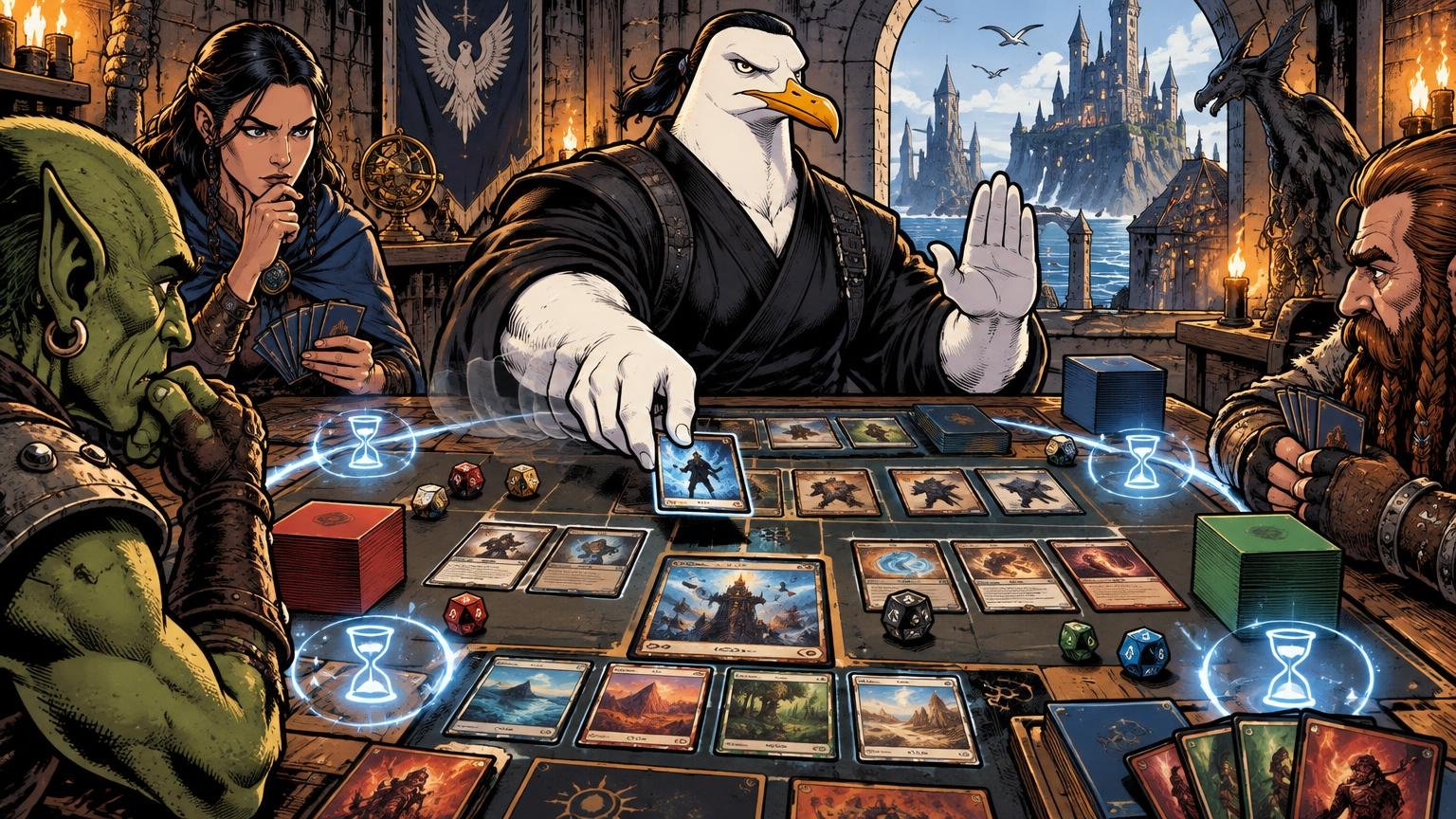
TLDR: Play decisively, not mysteriously
Good fast Commander play etiquette is simple: plan before your turn, announce meaningful actions and choices, mark board changes immediately, and pause wherever an opponent may reasonably respond. Speed is excellent. Speed combined with silence is how four adults spend ten minutes reconstructing a battlefield from dice, memories, and allegations.
You do not need to ask whether everyone passes priority after every basic land or routine mana ability. You do need to make consequential spells, targets, triggers, phase changes, and shortcuts clear. A fast player saves time without taking information or decisions away from the rest of the table. That is the mission.
Fast Commander play etiquette begins before the first turn
Commander is officially presented as a casual multiplayer format, commonly played as a four-player free-for-all, with pregame discussion used to align what players want from the game. Use that discussion to establish more than deck strength. Ask how the group handles shortcuts, take-backs, combo explanations, unfamiliar cards, and requests to slow down.
A useful pregame agreement can be brief: “I play quickly and use shortcuts, but interrupt me whenever you need a response window or explanation.” That sentence establishes speed without declaring yourself the table’s unelected air-traffic controller.
Some players need more narration because they are learning the format, reading unfamiliar cards, processing a crowded battlefield, or using accessibility accommodations. Respecting that is not slow play. It is functional multiplayer communication. The same principle applies when introducing proxies to a new group: discuss expectations rather than launching cardboard surprises across the perimeter. Our guide to MTG proxy etiquette for a new Commander playgroup covers that conversation in more detail.
For broader format questions, the Commander FAQ is also a useful authority reference. Your pod can still choose its own casual conventions where the rules do not prescribe a social policy.
Do your thinking before your turn
The fastest turn is usually prepared during the previous three turns. Watch the battlefield, identify your likely land drop, count available mana, and decide on a default line before you untap. Keep one contingency for meaningful changes. You do not need seventeen alternate plans for the possibility that Trevor draws a Swamp.
Preparation does not mean mentally leaving the game. Opponents’ attacks, spells, and permanents can change your line. Stay engaged, update the plan, and read unfamiliar cards when they enter rather than waiting until they threaten you personally.
Physical organization also saves time. Group lands so colored sources are easy to count. Keep your graveyard in one place. Separate tokens from the battlefield until they exist. Put counters directly on the objects they modify. If you use proxies, make sure their names, mana costs, types, and rules text can be identified without conducting a forensic examination.
Use concise action checkpoints
For most game actions, one clean sentence is enough. Announce the spell or ability, state targets and required choices, then stop long enough for the table to react. After resolution, summarize any material result before continuing.
- “Cast Beast Within targeting Rhystic Study.”
- “Activate my commander, targeting your graveyard.”
- “This resolves: I create two tokens and put one counter here.”
- “Move to combat?”
- “Go to my end step; I have an end-step trigger.”
These checkpoints are short, but they preserve the information opponents need. Do not compress “cast removal, kill that, attack you for twelve, second main, pass” into one breath. That is not a turn. It is a hostage note.
Priority without a committee meeting after every spell
Under the Comprehensive Rules, a spell or ability resolves only after every player passes priority in succession. The player who casts a spell or activates an ability normally receives priority again afterward. In casual Commander, players usually communicate this through ordinary pauses and established shortcuts rather than formally announcing every priority pass.
Pause clearly around leverage points: consequential spells, removal, stack interaction, combat transitions, end-step actions, activated abilities with important targets, and anything that could plausibly end the game. Look around the table. Give people enough time to say something. Then continue.
If you intend to take another action before opponents can respond to the first one, say that you are retaining priority. For example: “Cast this, retain priority, and activate this ability.” Announcing it matters because silently placing several objects on the table can look like you assumed the first one resolved.
Conversely, opponents should request priority promptly. “Before that resolves” or “during beginning of combat” is clearer than waiting through three more actions and then announcing that you meant to respond in the ancient past.
Announce triggers and mark board changes
Triggered abilities do not interrupt an event at the instant their condition occurs; they wait to be put on the stack until the next time a player would receive priority. At a casual table, the practical lesson is to identify relevant triggers before racing into the next sequence. This is guidance for clarity, not an attempt to import competitive missed-trigger enforcement into your kitchen.
Routine triggers can be grouped when their order and individual resolution do not change anyone’s decisions. “Three creatures entered, so these three identical draw triggers happen” may be sufficient. Separate them when targets, choices, ordering, intervening actions, or outcomes matter.
Every material board change should become visible immediately. Do not promise to remember six floating mana, a temporary power bonus, and which face-down token is secretly a copy of something across the table. Memory is not a game component, and mine once escaped through a skylight.
- Update life totals and commander damage as they change.
- Place counters on the correct permanent and use distinguishable counter types.
- Represent tapped, attached, transformed, copied, stolen, or phased-out objects clearly.
- Identify tokens by name and relevant characteristics.
- State temporary effects, including how long they last.
- Keep global effects visible and mention them when they alter another player’s action.
- Make copied spells and abilities identifiable on the stack.
Tournament policy treats visible game objects, counters, status, the active player, the current phase, and continuing effects as information players must be able to access. Commander is usually casual rather than tournament play, but this remains an excellent battlefield-legibility standard. For one recurring bookkeeping emergency, use a consistent Commander damage tracking method instead of asking the table to reconstruct three combats.
Shortcuts must have a clear exit ramp
Magic permits shortcuts when players understand the proposed sequence and resulting game state, including repeated sequences. A good shortcut states what repeats, how many times it repeats when that matters, and what the final result will be.
For a combo, demonstrate or explain one legal iteration. Identify the resources consumed and produced, any required targets or choices, and the intended repeat count or result. Then ask whether anyone wants to act at a particular point. Tournament policy expressly allows a player to interrupt a proposed shortcut by identifying where they want to take an action.
A clean explanation might be: “I activate this, untap these two permanents, and net one mana. I propose repeating that sequence twenty times, ending with twenty additional mana. Does anyone act during an iteration?” That is fast, auditable, and merciful.
Do not summarize a loop as deterministic when future iterations depend on unknown cards, random results, changing targets, or decisions that cannot yet be specified. Resolve those uncertain parts as they occur. A shortcut is a shared description of legal actions, not a license to announce that probability has surrendered.
Combat needs two clean checkpoints
Say “move to combat?” before declaring attackers. This gives opponents a clear chance to act before combat or during the beginning of combat step, depending on what they specify. Once attackers are declared, identify each attacker and the defending player, planeswalker, or battle it is attacking.
State combat-relevant changes when they occur: power and toughness modifications, menace, trample, deathtouch, first strike, attack triggers, and effects that restrict blocking. Opponents should not have to discover lethal damage by rotating their head forty-five degrees and reading a permanent beneath your water bottle.
At the end of the turn, say “go to end step” if you or another player may have end-step actions or triggers. Say “pass” only when you are actually finished. Clear phase transitions eliminate more confusion than performative speed ever will.
When the correct move is to slow down
Fast players earn trust by recognizing when speed becomes dangerous. Slow the operation when someone requests a card’s text, a tutor introduces a new object, the stack becomes complicated, hidden information affects a decision, timing is disputed, or the battlefield has materially changed.
Also stop for a board recap. Give accurate life totals, relevant blockers, known interaction, commander damage, continuing effects, and any public information affecting the decision. Tournament policy allows some out-of-order sequencing when the result is legal and clearly understood, but an opponent can require the proper sequence when they need to respond at the correct point. That principle is equally useful at a casual table: efficiency never overrides another player’s meaningful decision.
The fast-play field checklist
- Plan your default line before you untap.
- Keep watching the game while planning.
- Announce spells, abilities, targets, and meaningful choices.
- Pause at consequential response windows.
- Say when you retain priority.
- Use clear combat and end-step transitions.
- Group only routine triggers whose separation does not matter.
- Mark counters, tokens, attachments, copies, and temporary effects immediately.
- Explain one legal combo iteration before proposing repetition.
- Let opponents interrupt a shortcut at a specified point.
- Slow down for unfamiliar cards, complex stacks, tutors, timing questions, and recap requests.
Speed is a service to the table
The best fast Commander players are not merely quick. They are easy to follow. Their boards are legible, their shortcuts are reversible at meaningful intervention points, and their opponents never have to fight for the right to understand what is happening.
Prepare early, narrate only what matters, and pause where decisions live. If the table can audit your turn without excavating the game state afterward, the operation succeeded. If nobody knows how you produced forty-seven Treasures, return to the briefing room.